


If you have ever made my Sourdough Soft Sandwich Bread, you already know this dough. It is almost identical baker’s percentages to my light brioche base. A little more sugar, a touch less salt, one egg yolk thrown in for extra richness.
Thank you for reading this post, don't forget to subscribe!Here is the thing about cinnamon rolls. They are actually a pretty simple pastry when you break it down. An enriched dough, a butter and cinnamon sugar filling, and frosting! But the second you add natural leavening into the mix, you are in a different territory. (New to sourdough? Grab my free beginner’s ebook here and start there first.) These rolls require patience. If you underproof this dough, they turn out dense and dry. If you don’t knead it enough, they turn out gummy and underbaked and dense. But once you get it right… pure MAGIC!
The filling is full bakery-style. Generous, deeply spiced, and I add cornstarch right into the cinnamon sugar mix, which is a game-changer. It sounds a little odd but it absorbs the butter as it melts in the oven and keeps everything right where it belongs instead of pooling out the bottom of the pan. And the frosting… oh, the frosting. My customers have said they could drink it and I take that as the highest compliment. It is pourable and glossy and it just melts into every crevice of the warm rolls.
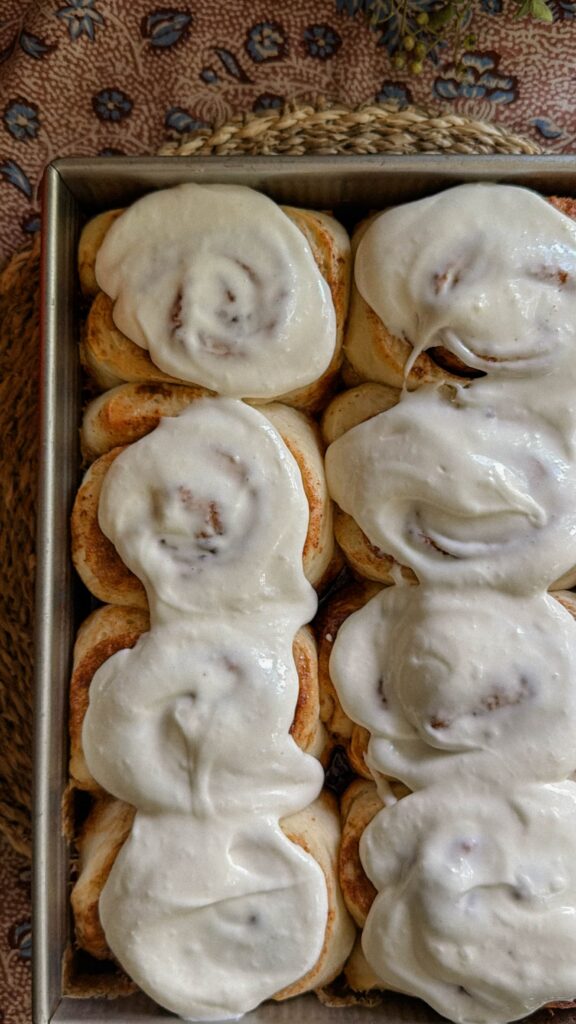
What are sourdough cinnamon rolls?
Cinnamon rolls made with a naturally leavened brioche dough. The dough is enriched with whole milk, butter, egg, and egg yolk which gives you this soft, pillowy, almost cloud-like crumb. The long fermentation adds a gentle tang that balances beautifully against the sweet cinnamon filling. It is really something special.
I prefer a light brioche over a French or classic brioche for sourdough cinnamon rolls. Because there is no instant yeast and the dough is 100% naturally leavened, a lighter enrichment helps the proofing along and keeps things moving without weighing the dough down.
How do you make sourdough cinnamon rolls?
There are three parts: the dough, the filling, and the frosting.
The dough comes together quickly and then does a long bulk ferment either overnight or during the day while you get on with life. Once it has doubled and is nice and puffy, you roll it out, spread on the filling, roll it up tight, slice it, and let it proof again. Then you bake it and frost it while it is still warm.
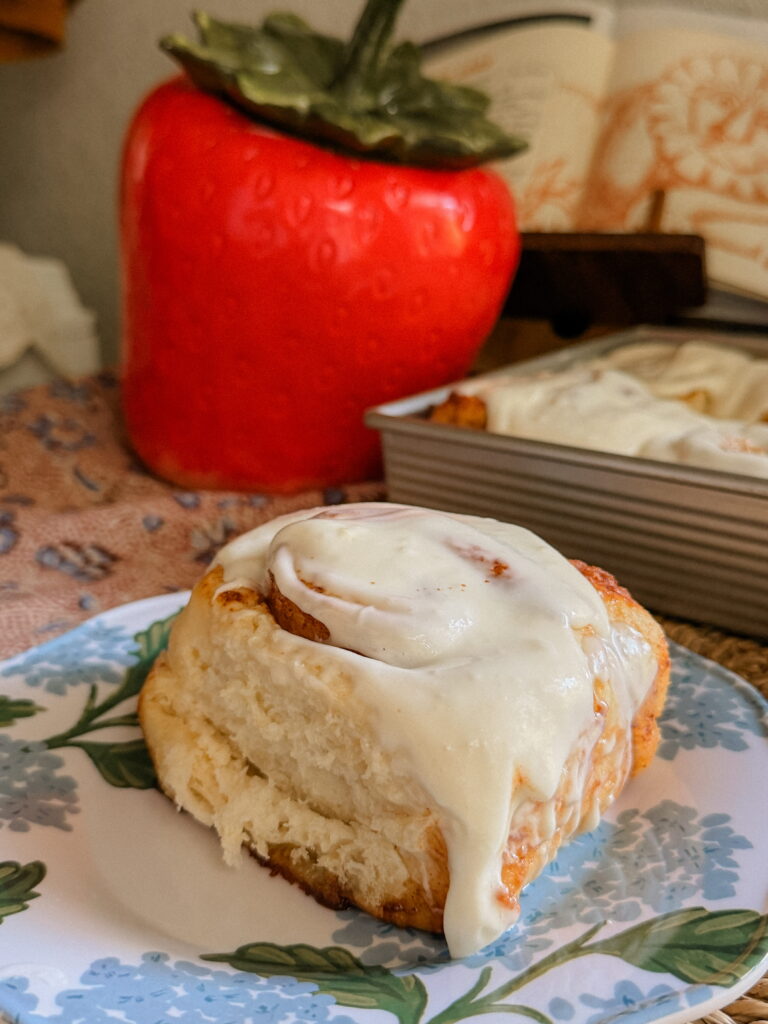
What makes this recipe different?
- The dough is (almost) my light brioche base. If you have made my sandwich bread you are already halfway there. The baker’s percentages are nearly identical, so once you know this dough, you know it for basically everything.
- The cornstarch trick. Mixed right into the cinnamon sugar, it keeps the filling thick and gooey and caramelized rather than greasy and leaky.
- The drinkable frosting. My cream cheese frosting is intentionally loose and pourable so it soaks into the rolls while they are still warm. It sets slightly as it cools but stays silky and rich. My customers rave about it, and I’m so proud of it!
What do you serve these with?
A cuppa. That is genuinely all you need. These rolls are a full experience on their own and they really don’t need anything else alongside them. Whether that is a strong black coffee, a latte, or a good cup of tea, you are sorted.
Are sourdough cinnamon rolls sour?
Just a tad 😉 Because these are made with a sourdough starter, there is a layer of flavor that is just a tad acidic. But here is the thing… it is delicious. Once you understand the depth of flavor that natural fermentation adds, you will never want to go back to a standard cinnamon roll. It is just on a different level. When I was developing this recipe, I did play around with perhaps a sweet starter, but in terms of overall flavor depth, this recipe made with a standard sourdough starter won. And as a bonus, the long fermentation makes them easier on the gut if you are sensitive to gluten.
Can you prep these ahead of time?
Yes! After the second proof you can cover the pan and refrigerate. The next day, bake them straight from the fridge (you may need to add a couple extra minutes bake time).
How do you store sourdough cinnamon rolls?
Cover and store at room temperature for up to 2 days. To reheat, pop them in a 300F oven for about 8 minutes or microwave for 20-30 seconds.
For longer storage, freeze them unfrosted and individually wrapped. Thaw at room temperature and frost before serving. And the frosting freezes beautifully too! I always make extra and freeze a batch so I have it on hand whenever I need it.
Bulk Baking Cinnamon Rolls
I have to tell you a story.
A couple of years ago I baked cinnamon rolls for my customers and it was a nightmare. I had just gotten a new mixer and it was my first time making that much dough at once. I kneaded it for the same amount of time I would for a single batch, except I was doing a 15x batch. And because I didn’t really know how to do the windowpane test properly at that point, I had no idea the gluten hadn’t developed enough. The rolls weren’t proofing right, the dough felt off, and after I baked them they were gummy and dense and tough. Just not good.
It was such a humbling moment. A real reminder that I am a home baker, not a commercial one, and that scaling up is a skill all on its own. It knocked my confidence and I have been avoiding putting cinnamon rolls on the menu ever since.
But I have been working on this recipe. I have worked on my skills as a baker. And I am ready 🥺
This week I am bulk baking cinnamon rolls and I will come back and update this section with my full process, scaling notes, and everything I learn along the way. Stay tuned!
Sample Timelines
These rolls are best suited to a weekend when you are home during the day. The dough loves warmth, but be careful about using too much heat to speed things along during that second proof. You don’t want the butter melting out before they even hit the oven.
Sample Timeline 1: Weekend Bake
| TIME | STEP |
| Morning, Day 1 | Feed your starter (make the levain) |
| Evening, Day 1 | Mix the dough |
| Overnight | First rise |
| Morning, Day 2 | Shape and begin second proof on the counter |
| When ready (once doubled in size) | Once the second proof is done, bake straight away or pop the covered pan in the fridge to pause proofing and bake anytime within the next 24 hours |
Sample Timeline 2: Morning Dough, Evening Bake
| TIME | STEP |
| Evening, Day 1 | Feed your starter |
| Early morning, Day 2 | Mix the dough |
| around 2pm, Day 2 | First rise at room temperature |
| 2pm, Day 2 | Shape and begin second proof |
| 2pm – 6pm, Day 2 | Second proof in a warm place |
| 6pm, Day 2 | Bake! |
These times are a guide, not a rule. Every kitchen is different and your dough will move faster or slower depending on the temperature of your home and of your dough. Pop the pan somewhere warm to help that second proof along. Always go by the look and feel of the dough. The first rise is ready when the dough is puffy and roughly doubled. The second proof is ready when the rolls are touching in the pan, feel light and airy, and spring back slowly when you gently press one with your finger.
Quick Overview
- Mix the dough and bulk ferment until doubled in size
- Make the cinnamon sugar filling
- Roll out, fill, and slice into 8 larger rolls or 12 small ones.
- Second proof until puffy and doubled in size again
- Bake at 350F for 20-23 minutes
- Make the frosting and pour over warm rolls
Sourdough Cinnamon Rolls
Rate this RecipeIngredients
- 165 grams bubbly active sourdough starter
- 278 grams warm whole milk
- 50 grams melted butter
- 1 whole egg
- 1 egg yolk
- 56 grams sugar
- 500 grams all-purpose flour
- 6 grams salt
- 115 grams softened butter room temperature, salted
- 240 grams brown sugar
- 2 TBS cinnamon
- 1 tsp vanilla extract
- 1 TBS corn starch
- 120 grams heavy cream to pour over rolls before baking
- 220 grams full fat cream cheese (1 block) softened
- 113 grams salted butter (1 stick) softened
- 240 grams powdered sugar sifted
- 2 tsp vanilla extract
- 2-4 TBS whole milk, to a pourable consistency
Equipment
- 9×13 baking pan
- Rolling Pin
- sharp knife or non-flavored dental floss to cut the rolls
Method
- Melt the butter in a small saucepan over low heat. Add the milk and keep on a low heat until warm to the touch. Remove from heat.*If you are planning on doing the bulk ferment (first proof) overnight, don't warm the milk too much. The cooler milk temperature will help extend the dough proof time until the morning.
- Add the warm milk and butter mixture to the bowl of a stand mixer with the dough hook attachment, along with the sourdough starter, egg, egg yolk, sugar, flour, and salt. Mix on low for about 5 minutes or until everything is fully combined. You may need to stop the mixer a couple of times to scrape the sides of the bowl. Cover the bowl and rest for 30 minutes.
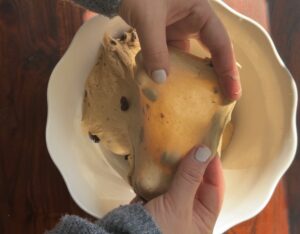
- After the dough has rested, knead on medium speed for 6-8 minutes until the dough is smooth, soft, and pulling away from the sides of the bowl. Do the windowpane test to confirm the gluten is properly developed before moving on. *The windowpane test: take a small piece of dough and stretch it gently between your fingers. If it stretches thin enough to let light through without tearing, it's ready! If not, knead for a few more minutes (example of the windowpane test below).
- Transfer to a lightly oiled bowl and cover with cling wrap or a damp cloth.
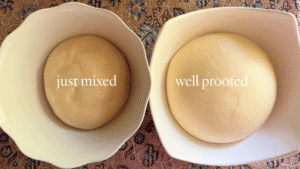
- Bulk ferment. Ferment at room temperature for around 6 hours or until puffy and roughly doubled.
- Make the filling. In a small bowl, mix together the brown sugar, cinnamon, vanilla extract, and cornstarch until fully combined. Set aside. Make sure your salted butter is softened and ready to spread, it should be at room temperature, spreadable but not melted.
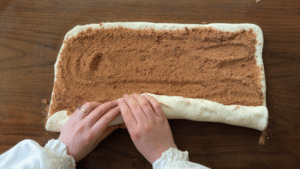
- Shape. Lightly oil your surface, as well as your hands and the rolling pin. Turn the dough out onto the surface and roll horizontally first to get it to roughly 16" for 8 larger rolls or 24" for 12 smaller rolls, and then roll vertically to get your rectangle.Spread the softened butter evenly across the entire surface, leaving a very small border at the top of the dough.Sprinkle the cinnamon sugar filling evenly over the butter and gently press it in with your hands.Starting from the long edge closest to you, roll the dough up tightly into a log.Use unflavored dental floss or a sharp knife to cut into 8 large rolls or 12 smaller ones. Place cut-side up in a greased 9×13 pan. Each roll should be less than 2" thick. *Any leftover sugar mixture that comes out of the dough when cutting, just sprinkle on top of the rolls once they're in the pan.
- Second proof. Cover and let proof at room temperature for 3-4 hours until puffy and the rolls are touching in the pan. This step requires patience, do not underproof.
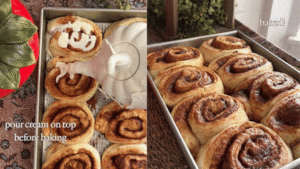
- Bake. Preheat oven to 350F (175C). Just before baking, pour the heavy cream evenly over the rolls.Bake for 20-25 minutes until golden on top and the centers are just set. You want them soft and pillowy, not crusty on top. Use a thermometer to check the insides are baked through. You are looking for an internal temperature of 190F (88C).Let cool for 10-15 minutes before frosting.
- Make the frosting. Beat the cream cheese and butter together until smooth and fluffy. Add the powdered sugar, vanilla, and salt and beat until combined. Add milk one tablespoon at a time until you reach a pourable but not watery consistency.
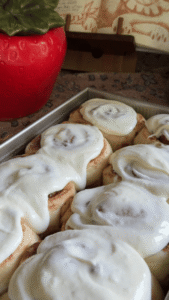
- Frost and serve. Pour the frosting generously over the warm rolls and let it melt down into all the crevices. Serve immediately.


I am so in love with this recipe. This is the most perfect sourdough cinnamon recipe I’ve tried and I have tried MANY. I use this to make for my customers and it’s such a pillowy soft bun.
Yayyyyy so glad you love it!!
Hello! Am I able to put these in the fridge after cutting? Will they develop a very tangy flavor if I do so? Thank you!
Hi Marla! I personally put them in the fridge to cold proof overnight after cutting/shaping when I bulk bake for my bakery and it works great. The longer they’re in the fridge though, the more tang it will develop. So I make sure they’re baked within 24hrs after I have put them in the fridge.
Hi Marla, personally I put them in the fridge after cutting just overnight. Any longer and they do seem to develop more of a sour flavor!
10/10! No notes these are perfect, I’ve tried many other cinnamon recipes those didn’t even come close. These are ones that will be a staple in my house!
Woohoo!! Thanks for sharing!
These are absolutely delicious!! Not only the best sourdough cinnamon rolls I’ve ever had, but the best across the board. Thank you for sharing!
Thank you so much for sharing!! I’m so glad you love it!